
TPO vs. Metal for Austin Commercial Roofs: Which Lasts Longer?
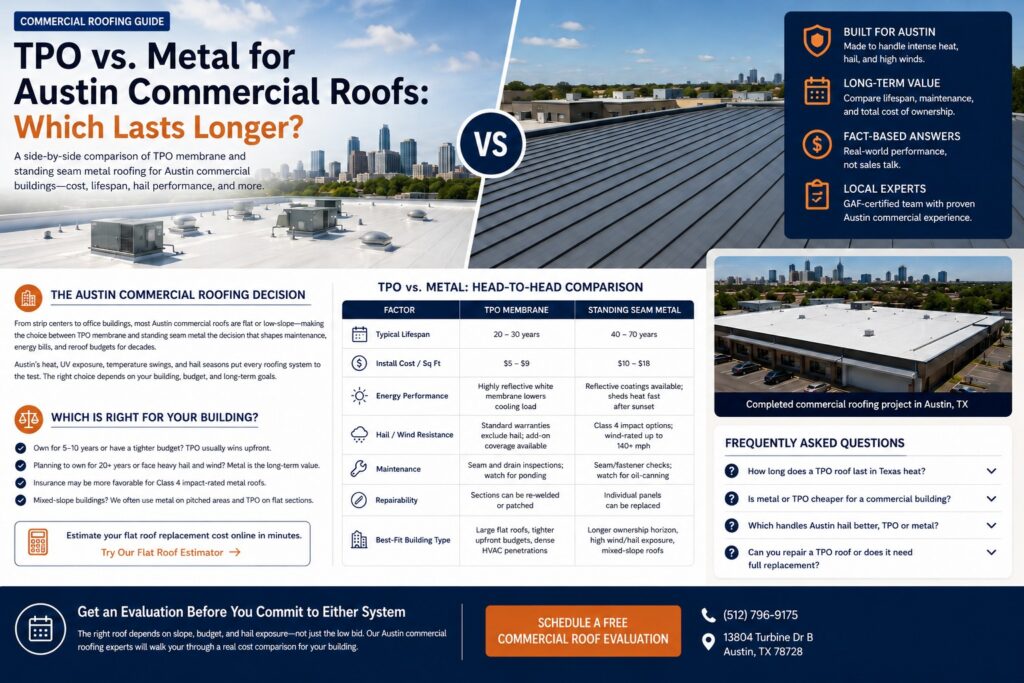
Comanche Roofing is a roofing contractor serving Austin and the surrounding Central Texas commercial market that installs and repairs both TPO membrane and standing seam metal roofing systems. For businesses researching commercial roofing in Austin, the real decision is not which material costs less to install. It is which material costs less over the next 20 years, once hail, heat cycling, and maintenance calls get added to the invoice.
Table of Contents
ToggleThe Austin Commercial Roofing Decision
Most Austin commercial buildings, from strip retail centers to warehouses and mid-rise office buildings, are built with flat or low-slope roofs, which rules out asphalt shingles and narrows the real decision down to a membrane system like TPO or a metal system like standing seam. That choice shapes the building’s maintenance calendar, energy bills, and reroof budget for decades, so it deserves more scrutiny than the lowest bid on the install. A roof with dense HVAC penetrations, frequent foot traffic, or a tight capital budget often points toward one material over the other well before cost per square foot even enters the conversation. Austin adds its own stress on top of the ordinary wear a flat roof takes elsewhere: intense UV exposure for most of the year, wide temperature swings between summer afternoons and winter mornings that expand and contract every seam and fastener, and hail seasons that test whichever material is on top. A roofing decision that ignores any one of those three tends to show up as a service call within the first five years.
TPO Roofing: Strengths and Weak Points
TPO (thermoplastic polyolefin) is a single-ply membrane, heat welded at the seams, and it remains one of the most common commercial roofing choices because the material itself is inexpensive and the install goes quickly. In Austin, TPO installation commonly runs in the 5 to 9 dollar per square foot range, and most membranes carry manufacturer warranties in the 20 to 30 year window, with thicker 60 and 80 mil membranes holding up better than a standard 45 mil membrane. White TPO is highly reflective, which helps commercial HVAC systems work less during Austin summers. Because TPO does not include insulation, the roof assembly also needs a separate board, commonly polyisocyanurate, sized to the building’s target R-value, which is a detail worth confirming in any commercial bid. Installation method affects performance as much as the membrane itself. Mechanically attached systems, fastened through the insulation into the deck, install fastest and cost less, but every fastener is a potential penetration point. Fully adhered systems, bonded to the substrate with adhesive, cost more in labor but eliminate that fastener risk and generally perform better under wind uplift, which is one reason Comanche Roofing recommends a fully adhered system on most Austin re-roof projects.
The weak points show up over time rather than on day one. TPO seams run every 6 to 8 feet, and while a properly hot air welded seam is strong, a rushed or improperly welded seam is where leaks start. Flat and low slope roofs are also more prone to ponding water than a sloped metal roof, and standing water accelerates membrane wear at exactly the low points where seams and drains already take the most stress. That risk is well illustrated by Comanche Roofing’s TPO leak case study on an Austin flat roof: the original mechanically attached membrane had ponding at the drains and corners from a lack of proper slope, on top of years of DIY patch attempts that never solved the underlying drainage problem. It is also worth knowing that most manufacturer warranties do not cover hail or impact damage by default, which matters in a market that sees Austin’s hail seasons.
Standing Seam and Metal Roofing: Strengths and Weak Points
Standing seam metal is the other end of the trade-off: higher upfront cost for a roof built to outlast two or three TPO replacement cycles. Comanche Roofing’s metal roofing team installs commercial-grade steel standing seam systems that commonly run 10 to 18 dollars per square foot installed, and a properly installed system routinely reaches 40 to 70 years of service life, with wind ratings tested up to 140 plus mph. Panel gauge and finish both affect that performance: a heavier 24 gauge panel holds up to hail and wind better than a lighter 26 gauge panel, and a Kynar or PVDF factory finish adds long term color retention and reflectivity on top of the base metal’s durability. That wind performance, plus impact-resistant panel options, is why standing seam holds up well through Austin’s hail and wind events. Attachment matters here too. Standing seam panels are typically installed with floating clips that let the metal expand and contract with temperature without tearing loose, and a crew unfamiliar with that detail is far more likely to produce visible oil-canning or, worse, fastener stress over time.
Metal’s most common complaint is oil-canning, the wavy or rippled look that can appear in flat panel areas after installation. It is a cosmetic issue rather than a structural one, caused by installation stress, thermal expansion and contraction, or waviness already present in the metal coil, and it is largely preventable with the right panel profile and installation technique, a topic Comanche Roofing’s oil-canning causes and fixes post covers in more detail. Metal roofs also require more specialized installation than TPO, which narrows the pool of contractors qualified to do the work correctly and is worth confirming before a bid is accepted. One more factor worth a conversation with a contractor: an existing TPO roof in decent structural condition can sometimes be recovered with a new membrane instead of a full tear-off, which lowers the cost of a second TPO cycle and is worth asking about before assuming a full replacement is the only option.
Head-to-Head: TPO vs. Metal
Factor | TPO Membrane | Standing Seam Metal |
Typical lifespan | 20 to 30 years | 40 to 70 years |
Install cost / sq ft | $5 to $9 | $10 to $18 |
Energy performance | Highly reflective white membrane lowers cooling load | Reflective coatings available; sheds heat fast after sunset |
Hail / wind resistance | Standard warranties exclude hail; add-on coverage available | Class 4 impact options; wind-rated to 140+ mph |
Maintenance | Seam and drain inspections; watch for ponding | Seam/fastener checks; watch for oil-canning |
Repairability | Sections can be re-welded or patched | Individual panels can be replaced |
Best-fit building type | Large flat roofs, tighter upfront budgets, dense HVAC penetrations | Longer ownership horizon, high wind/hail exposure, mixed-slope roofs |
Which Is Right for Your Building?
For property owners planning to hold the building for 5 to 10 years, or working with a tighter upfront capital budget, TPO usually wins on cost, provided the installer gets the slope and drainage right the first time. For owners planning to hold longer, or for buildings that take a direct hit every hail season, the higher upfront cost of standing seam metal is usually worth it, since it avoids the 20 year replacement TPO eventually needs. Insurance is worth factoring in too: some commercial policies price hail and wind coverage more favorably for a Class 4 impact-rated metal roof than for a standard TPO membrane, which can offset part of the higher install cost over time. Comanche Roofing’s Cody Profitt is a GAF certified roofer who has installed both systems across Austin’s commercial market, and the standard recommendation on mixed-slope buildings, where part of the roof is flat and part is pitched, is to run metal on the pitched sections and TPO on the flat sections rather than forcing one material onto a roof it was not designed for.

- Comanche Roofing in Austin
- (512) 796-9175
- 13804 Turbine Dr B, Austin TX 78728
- MON - SAT: 8AM TO 5PM
- Sunday: CLOSED
- Comanche Roofing in San Antonio
- (210) 201-2431
- 3918 Naco Perrin Blvd ste 113 San Antonio, TX 78217
- MON - SAT: 8AM TO 5PM
- Sunday: CLOSED
Schedule your free quote and inspection now!

TPO vs. Metal Roofing for Austin Commercial Buildings
TPO vs. Metal for Austin Commercial Roofs: Which Lasts Longer? Comanche Roofing is a roofing contractor serving Austin and the surrounding Central Texas commercial market

Best Roofing for Texas Heat: Energy-Efficient Options (2026)
Best Roofing for Texas Heat: Energy-Efficient Options That Cut Cooling Bills Comanche Roofing is a roofing contractor serving Austin, San Antonio, and the surrounding Central
Roof Damage Near The Rim, UTSA & The Dominion? Free Inspections
Tornado Roof Damage in Northwest San Antonio: Free Inspections for Affected Neighborhoods The EF-1 tornado that touched down the morning of July 15 didn’t hit
Get your free quote now!

Cody Profitt
Cody has built a reputation in the Austin area as the go-to source for installing complex roofing systems. He works directly with custom home builders on waterproofing high- end modern homes other roofers wont touch. In his free time, Cody likes to be with his growing family and playing guitar.
Frequently Asked Questions
How long does a TPO roof last in Texas heat?
A properly installed TPO roof typically lasts 20 to 30 years in Texas, with thicker membranes and fully adhered installations holding up best against the UV exposure and heat cycling that Central Texas summers bring.
Is metal or TPO cheaper for a commercial building?
TPO is cheaper upfront, commonly running 5 to 9 dollars per square foot installed compared to 10 to 18 dollars for standing seam metal. Metal costs more to install but lasts roughly twice as long, so the cheaper material is not always the cheaper choice over a 40 year ownership horizon.
Which handles Austin hail better, TPO or metal?
Standing seam metal, particularly with a Class 4 impact-resistant rating, generally holds up better against hail than standard TPO. Most TPO manufacturer warranties exclude hail and impact damage unless additional coverage is purchased separately.
Can you repair a TPO roof or does it need full replacement?
Most TPO problems, including seam failures and localized punctures, can be repaired by re-welding or patching the affected section. Full replacement is usually only necessary once the membrane has widespread wear, chronic ponding damage, or has already exceeded its service life.