
24/7 Storm Response — We Stop the Leak Tonight
Emergency Roof Tarping in Austin & San Antonio, TX
When a hailstorm, straight-line wind, or a fallen limb opens up your roof, every hour the sky is exposed is another hour of water soaking into your ceilings, insulation, and walls. Comanche Roofing provides fast, professional emergency roof tarping across the Austin and San Antonio metros — securing your home with a properly fastened, weather-rated tarp so the damage stops while we plan the permanent repair.
Our crews are GAF-certified, licensed, and insured, and our San Antonio office runs around the clock. Call the location nearest you and we’ll get a tarp over the opening as fast as conditions allow:
Schedule your free quote and inspection now!

Comanche Roofing Accreditations



Austin Texas: (512) 796-9175 | San Antonio Texas: (210) 201-2431
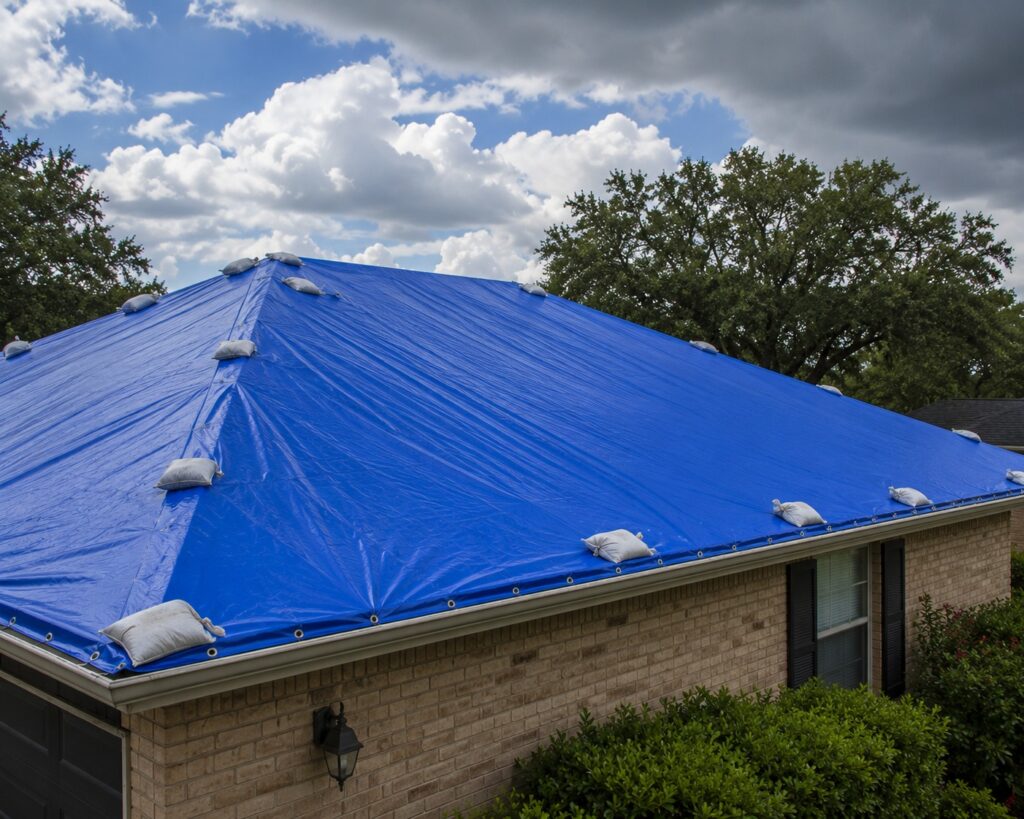
What Is Emergency Roof Tarping?
Emergency roof tarping is the installation of a heavy-duty, waterproof tarp over a damaged section of roof to stop water from getting inside after hail, high wind, a tree impact, or sudden structural failure. Think of it as a tourniquet for your home: it isn’t the cure, but it stops the bleeding until the permanent repair can be done safely and correctly.
A tarp done right is not a hardware-store sheet held down with bricks. Our installers extend commercial-grade poly tarp well past the damaged area and mechanically fasten it to the roof deck and framing with battens, so it holds through the next round of Texas wind and driving rain. Done properly, this can cut water intrusion dramatically compared with a loose-laid tarp that balloons and tears in the first gust.
Common situations that call for emergency tarping include:
- Missing, lifted, or shattered shingles after a hailstorm or windstorm
- Punctures or holes from fallen branches and storm debris
- Lifted or peeled metal panels and failed seams
- Damaged flashing around chimneys, vents, and skylights letting water in
- Exposed roof decking visible from the ground
Get Your Free Roof Estimate
Answer 4 quick questions and get an instant price range — no obligation, no sales pressure.
What type of roof do you need?
Tell us about your home
The steeper the roof, the more surface area — and the more material required.
Choose your materials & warranty
Almost there — where’s the property?
Signs You Need Emergency Tarping Right Now
Don’t wait until water is dripping through a light fixture — by then the damage has already spread into the structure. If you see any of the following after a storm, call us before the next rain band arrives.
Interior Warning Signs
- Active drips or running water from the ceiling
- Water stains that are spreading across a ceiling or wall
- Bubbling, blistering, or peeling paint
- Damp or matted attic insulation
- A musty, damp smell after rain — an early sign of mold
Exterior Warning Signs
- Missing or cracked shingles across roughly 10–20% or more of the roof
- Visible holes, or roof decking exposed to open sky
- A tree limb or heavy debris resting on the roof
- Displaced ridge caps or metal panels lifted along the seams
- Torn or missing flashing around penetrations
Why the First 24 Hours Decide Your Repair Bill
Secondary water damage — the ruined drywall, insulation, flooring, and framing that follow a leak — makes up the large majority of total storm-repair cost. The roof opening itself is often the cheapest part to fix; it’s what the water does after it gets in that drives the bill into five figures.
Here’s what a delay costs you:
- A single storm can soak insulation, ceilings, wall cavities, and flooring through one unprotected opening.
- Mold can begin growing in trapped moisture within 24–48 hours — and Central and South Texas humidity speeds that up.
- Wet insulation loses much of its R-value, raising your cooling bills.
- Prolonged moisture weakens wooden rafters and decking, turning a repair into a partial rebuild.
Tarping fast is the difference between a contained repair and a full interior restoration. It also protects your insurance claim — more on that below.
Our Emergency Roof Tarping Process
When you call, we move quickly but methodically. Every job follows the same disciplined sequence so the temporary cover actually does its job.
- Rapid dispatch. We take your call on our 24/7 line, triage the urgency, and route the nearest crew to your Austin- or San Antonio-area address.
- Safe damage assessment. We inspect from the ground and attic first, locate every point of intrusion, and photograph the damage for your records and your claim.
- Measure and prep. We size a single commercial-grade tarp with generous overlap on all sides and prepare the anchor battens on the ground.
- Install from the peak down. We anchor the high edge over the ridge so water runs over the tarp, pull it tight to kill wind-catching air pockets, and fasten battens into sound decking 4–5 feet beyond the visible damage.
- Verify and document. We confirm full coverage, reinforce corners and grommets against uplift, and hand you “after” photos plus an itemized invoice for your insurer.
- Plan the permanent fix. We schedule a full inspection and give you a clear repair-or-replace recommendation before the tarp’s service life runs out.
Emergency Roof Tarping in Austin, TX
Our Austin office in Wells Branch (13804 Turbine Dr B) puts crews within fast reach of the whole Central Texas hail belt. Austin sits squarely in an area that takes repeated spring and early-summer hail and straight-line wind, and older neighborhoods with mature trees see heavy limb-fall during those storms. We tarp residential, multifamily, and commercial roofs across Austin and the surrounding communities, and we coordinate directly with your adjuster so the temporary work and the permanent repair line up with your policy.
Emergency Roof Tarping in San Antonio, TX
Our San Antonio location (3918 Naco Perrin Blvd, Ste 113) is open 24 hours, so a 2 a.m. storm gets the same fast response as a midday one. San Antonio and the surrounding South Texas counties sit in Hail Alley too, and the mix of tile, metal, and asphalt roofs across the metro each needs a different tarping approach to seal correctly. Whether you’re a homeowner that needs a storm damage roof repair or a property manager with an exposed flat roof, we secure the building first and document everything for the claim.
Roof Tarping & Your Insurance Claim
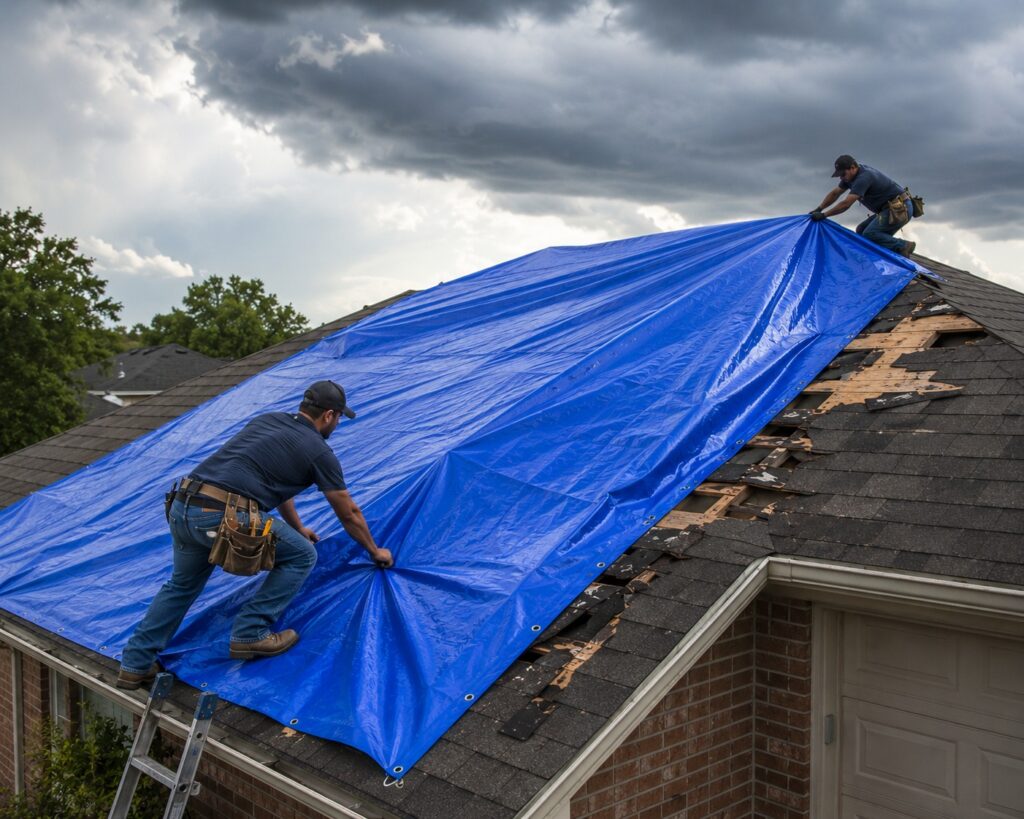
Texas homeowners policies generally require you to take reasonable steps to prevent further damage after a covered storm. Emergency tarping is exactly that step — and skipping it can give an insurer grounds to reduce or deny the avoidable part of your loss. We make compliance simple.
How we protect your claim:
- We photograph the damage before tarping, the materials and installation, and the finished cover — all timestamped.
- We provide an itemized invoice that separates emergency tarping from permanent repair, the way adjusters want to see it.
- We can meet your adjuster on site so the scope of work is agreed before permanent repairs begin.
Most policies reimburse reasonable tarping costs when the underlying damage is a covered peril such as wind, hail, or a fallen tree. Keep every receipt — we’ll help you assemble the rest.
DIY Tarping vs. Calling a Professional
A small, dry, accessible area on a single-story low-slope roof can sometimes be covered safely by a capable homeowner with the right gear. But the moment any of the following is true, the smart and safe move is to call a professional:
- The roof is steep (greater than a 6:12 pitch) or the home is more than one story
- There’s structural damage — sagging, broken rafters, or a tree still on the roof
- Multiple areas are damaged or large sections of decking are exposed
- Conditions are wet, windy, or it’s after dark
- You don’t have a harness, roof anchor, and a properly secured ladder
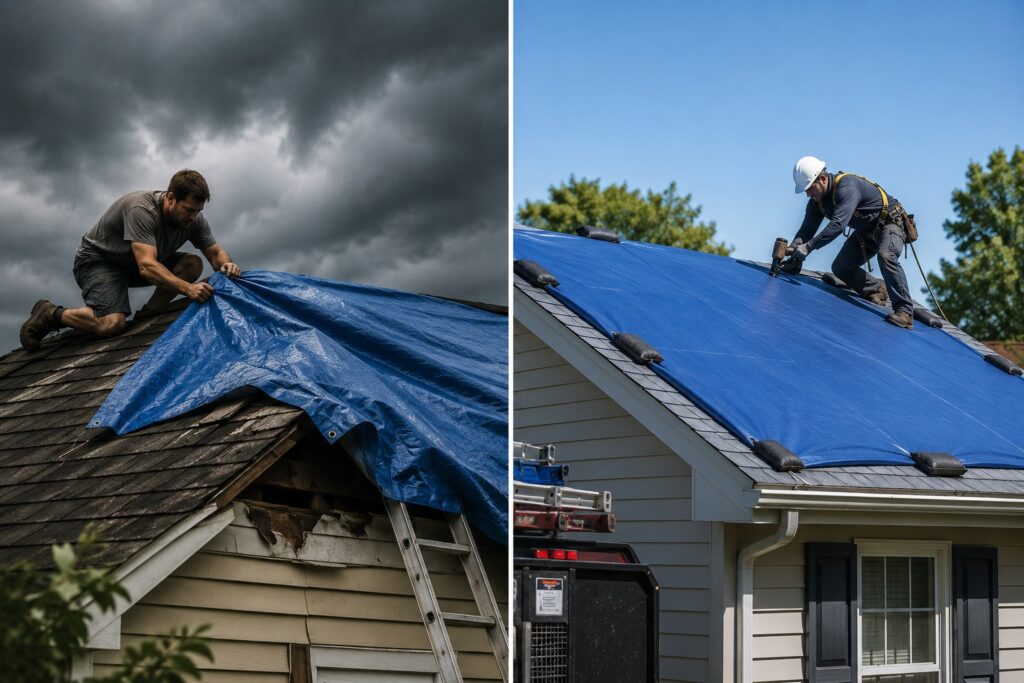
Falls account for a large share of roofing injuries, and amateur tarps fail far more often in high wind than professionally fastened ones. A poorly nailed tarp can also damage good shingles and complicate your warranty and your claim. When in doubt, stay off the roof and let our insured crew handle it.
How Long Can a Roof Tarp Stay On?
A tarp is a short-term measure, not a roof. Texas sun and heat degrade tarp material faster than most homeowners expect, so plan the permanent repair right away.
Tarp type | Expected life | Notes |
|---|---|---|
Standard poly (6–8 mil) | 30–60 days | UV breaks it down quickly in TX summer |
Heavy-duty poly (10–12 mil) | 60–90 days | Better tear and wind resistance |
Professional PVC | 90+ days | Needs periodic monitoring |
Leaving a tarp on too long traps moisture, accelerates deterioration of the surrounding roof, and can affect your manufacturer warranty. We’ll have your permanent repair or replacement scheduled well before the cover reaches the end of its life.
Why Central & South Texas Homeowners Choose Comanche Roofing
- Two local offices, fast response. Crews based in Austin (Wells Branch) and San Antonio, with 24/7 emergency coverage.
- GAF-certified, licensed & insured. Manufacturer-backed workmanship, not a storm-chaser with a truck and a ladder.
- Insurance-savvy. We document the damage and work directly with your adjuster from tarp to permanent repair.
- Top-rated locally. 4.9 stars in Austin and 5.0 in San Antonio from homeowners who’ve been through the storm with us.
- One company, start to finish. The crew that tarps your roof is backed by the team that repairs or replaces it — no handoffs, no finger-pointing.
Areas We Cover for Emergency Tarping
Austin & Central Texas: Austin, Wells Branch, Round Rock, Pflugerville, Cedar Park, Leander, Georgetown, Kyle, Buda, Lakeway, Bee Cave, Dripping Springs, and San Marcos.
San Antonio & South Texas: San Antonio and surrounding communities including Converse, Live Oak, Schertz, Universal City, Alamo Heights, and Castle Hills.
Our service areas
- Roofing Services Round Rock TX
- Roofing Services Cedar Park TX
- Roofing Services Leander TX
- Roofing Services Pflugerville TX
- Roofing Services Lakeway TX
- Roofing Services Bee Cave
- Roofing Services Kyle TX
- Roofing Services Buda TX
- Roofing Services San Marcos TX
- Roofing Services Dripping Springs TX
- Roofing Services Georgetown TX
- Roofing Services San Antonio TX
Testimonials
What our customers are saying
Trustindex verifies that the original source of the review is Google. We couldn’t recommend Comanche Roofing more. During our full home remodel, we ran into a few tricky roofing issues that previous roofers couldn’t figure out — but Cody was incredible. He showed up right away, walked us through our options clearly, and delivered a fantastic solution that has held up perfectly. Cody is honest, reliable, and extremely skilled. We trust him with all of our roofing needs, and we’ve already referred him to neighbors who ended up having their entire roofs redone with him — and they’ve all been just as happy. If you want someone who truly knows what they’re doing and cares about doing it right, go with Cody and Comanche Roofing.Posted on GoogleTrustindex verifies that the original source of the review is Google. Just had our roof replaced by Comanche and we are extremely pleased with the entire process. Working with Robert was easy and straightforward and the roofing crew did an amazing job, all the way down to the cleanup. Will happily recommend them to any friends in need of roof repair/replacement.Posted on GoogleTrustindex verifies that the original source of the review is Google. Excellent job on my roof. Looks great. No leaks. Good customer service. Highly recommend.Posted on GoogleTrustindex verifies that the original source of the review is Google. It's always great to work with Cody and his team at Comanche Roofing! They are super efficient and professional in their work ethic.Posted on GoogleTrustindex verifies that the original source of the review is Google. Comanche Roofing is absolutely great at what they do! Their team is professional, efficient, and delivers top-quality work every time. From start to finish, they make the process seamless and stress-free. It’s clear they take pride in their craftsmanship and stand behind their work. I would highly recommend them to anyone looking for a roofing company that’s reliable, skilled, and easy to work with.Posted on GoogleTrustindex verifies that the original source of the review is Google. Cody from Comanche Roofing was great. On time, did a thorough assessment and repaired what was needed. We certainly recommend him to our friends and neighbors and will be calling Comanche Roofing for our future roofing needs.Posted on GoogleTrustindex verifies that the original source of the review is Google. They were contracted to replace the roofing across 42 units of our condo community. Fast, out of the way, quiet, courteous, cleaned up after themselves. Would use again.Posted on GoogleTrustindex verifies that the original source of the review is Google. All I can say is that this company has a bunch of standout people. I highly recommend them. It’s truly hard to find a company with honesty and integrity and Comanche roofing absolutely personifies these Qualities. After my insurance company Treated me poorly and denied my coverages, Comanche roofing came through and was a light at the end of the tunnel. They helped me out when no one else would. Be confident in them to get the job done with great workmanship, and have peace of mind when you know you’re dealing with virtuous people.Posted on GoogleTrustindex verifies that the original source of the review is Google. Cody and team helped me diagnose a number of issues with a TPO roof on my relatively new build home. He was incredibly knowledgeable, and walked me through each issue. Given this was a relatively new build, we ended up working out an out of warranty fix with our builders. This would not have happened without Cody’s knowledge and willingness to help. Even once it became clear that the work wouldn’t land with Comanche, Cody helped me work toward the best outcome. Comanche roofing has 100% secured my future business and recommendations to family and friends.Posted on GoogleTrustindex verifies that the original source of the review is Google. Cody was fantastic and Comanche gets my absolute highest recommendation. We were extremely happy with his expertise and communication. Top notch all the way!
Frequently Asked Questions
How fast can you tarp my roof in Austin or San Antonio?
We run a 24/7 emergency line for both metros and dispatch as quickly as conditions allow — typically the same day for active leaks. During major hail or wind events demand surges across Central and South Texas, so the sooner you call, the sooner we can secure your home.
How much does emergency roof tarping cost?
Most residential emergency tarping jobs in our area run roughly $400–$2,000 depending on roof height, pitch, access, and the size of the damaged area. When the underlying damage is a covered peril, your homeowners insurance often reimburses reasonable tarping costs as required mitigation — and we document everything for your claim.
Will my insurance pay for emergency tarping?
In most cases, yes. Texas policies generally require you to prevent further damage after a covered storm, and tarping satisfies that duty. We photograph the damage, the materials, and the finished tarp, and provide an itemized invoice so your adjuster has what they need to approve reimbursement.
Should I tarp my own roof or call a professional?
A small, dry, single-story low-slope area can sometimes be handled safely with the right gear, but steep pitches, multi-story homes, structural damage, or standing debris call for a professional. Falls cause a large share of roofing injuries and DIY tarps fail far more often in high wind. When in doubt, stay off the roof and call us.
How long can a roof tarp stay on?
A standard poly tarp lasts about 30–60 days and heavier 10–12 mil material 60–90 days before Texas sun degrades it. A tarp is temporary only — schedule the permanent repair before the next storm season so trapped moisture doesn’t cause hidden rot.
Do you tarp commercial and flat roofs?
Yes. We secure residential, multifamily, and commercial flat and low-slope roofs in both the Austin and San Antonio markets, using the right method for each system so the cover actually sheds water until permanent work is done.
Roof Leaking Now? Call Comanche Roofing
Don’t let a few exposed shingles turn into a flooded ceiling. Comanche Roofing will tarp your roof fast, document it for your insurer, and follow through with the permanent repair. Call the office nearest you, day or night for a free roof estimate!