How to Choose a Roofing Contractor in Austin (and Avoid Storm Chasers)
After a Texas Hailstorm, the Door-Knockers Arrive
A severe hailstorm rolls through Central Texas, and within hours, unfamiliar trucks appear on residential streets across Austin. Magnetic signs, out-of-state license plates, and door-to-door sales pitches follow close behind. These traveling crews, commonly called storm chasers, move from region to region chasing insurance payouts rather than building lasting reputations in any one community. For Austin homeowners trying to make a fast decision after a storm, distinguishing a legitimate local Austin roofing company from a short-term operator is one of the most consequential choices they will make during the claims process.
Table of Contents
ToggleThis guide breaks down what to look for when choosing an Austin roofing contractor: the credentials that matter, the questions worth asking before signing anything, and the specific red flags that separate an established local company from a crew that will be gone before the next Texas storm season. Homeowners who already suspect hail or wind damage can start with Comanche Roofing’s storm damage roofing services while working through the vetting process below.
What a Storm Chaser Looks Like
Storm chasers follow predictable patterns, and most of them show up within days of a hailstorm or major wind event. A few signs tend to repeat across the industry.
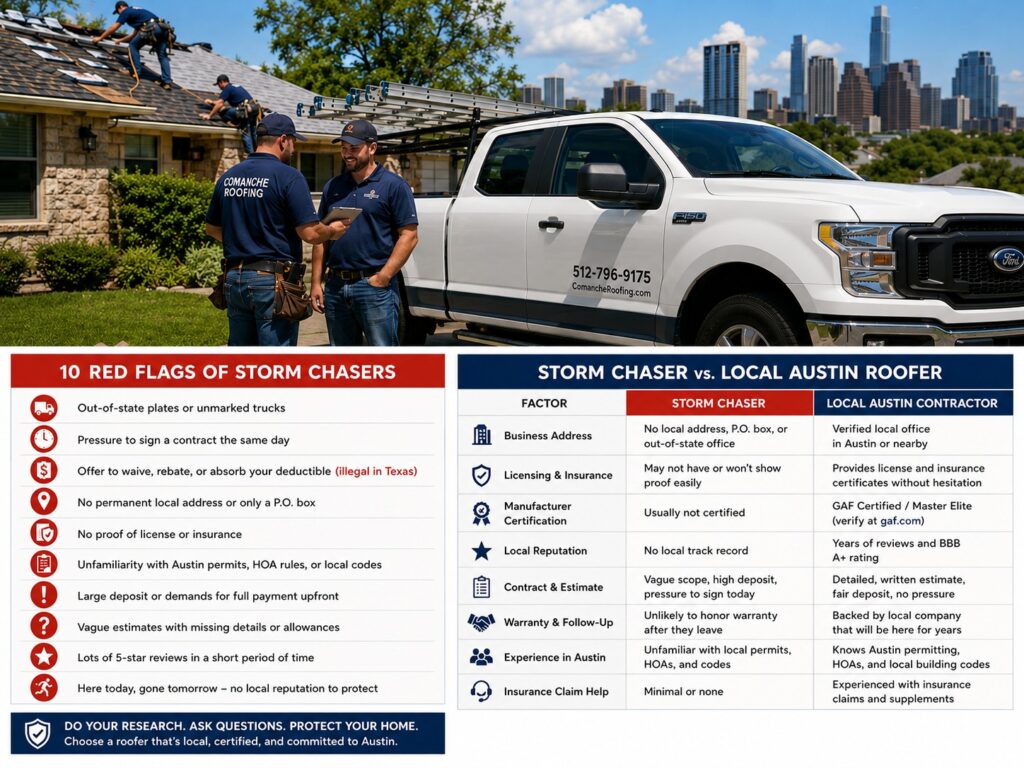
Out-of-state license plates or unmarked trucks are common, since many of these crews travel from state to state chasing storm damage rather than operating out of a fixed local base.
Pressure to sign the same day is another hallmark. Legitimate contractors expect homeowners to compare estimates and take time to review a contract. A crew pushing for an immediate signature is often more interested in locking in a deal before a homeowner can do that research.
An offer to waive the insurance deductible is one of the clearest warning signs of all, and it is also illegal in Texas. Under Texas Insurance Code Section 707.002, effective since September 2019, homeowners are required to pay any deductible that applies to a first-party property insurance claim. A contractor who offers to absorb, rebate, or waive that deductible is violating state law, not offering a discount.
No permanent local address is another common thread. A P.O. box, a residential address, or no address listed at all should prompt a homeowner to ask more questions before handing over a deposit.
Unfamiliarity with Austin permitting requirements, HOA rules, or the building codes specific to Travis and Bexar counties often surfaces once work begins, long after the contract is signed.
Credentials That Actually Matter
Not every credential carries the same weight, and homeowners evaluating an Austin roofing contractor should focus on the ones that are genuinely difficult to fake.
A local physical address, not just a phone number, is the starting point. Comanche Roofing operates two staffed offices in Central Texas: one at 13804 Turbine Dr, Suite B in Austin, and a second at 3918 Naco Perrin Blvd, Suite 113 in San Antonio. That kind of standing local footprint is something a storm-chasing crew working out of a pickup truck simply does not have.
Manufacturer certification matters more than most homeowners realize. GAF certification, for example, requires ongoing training and a proven installation record, and homeowners can verify any contractor’s certification status directly through GAF’s contractor locator before signing anything.
Licensing and insurance protect the homeowner if something goes wrong mid-project. A contractor should be able to produce proof of both without hesitation.
Review depth matters more than a five-star average by itself. A contractor with hundreds of reviews spanning several years shows a pattern of sustained work in the community, while a handful of five-star reviews posted in the same month can be a sign of a newer or less established operation.
A workmanship warranty that outlasts the crew matters too. Comanche Roofing backs installations with the Comanche Lifetime workmanship warranty on top of manufacturer material warranties, and holds an A+ rating with the Better Business Bureau.
Questions to Ask Before You Sign
A short list of direct questions can separate a legitimate contractor from a crew that will not be around for the warranty period.
- Can you provide your physical business address and a local phone number?
- Are you licensed and insured, and can I see proof of both?
- What manufacturer certifications do you hold, and can I verify them independently?
- How long have you operated in the Austin or San Antonio area?
- Can you provide references from jobs completed in the past two years?
- What does your workmanship warranty cover, and for how long?
- Will you provide a written, itemized estimate before any work begins?
- What is a fair deposit amount, and when is the remaining balance due?
- Who handles communication with my insurance adjuster if I am filing a claim?
- What happens if hidden damage is discovered once the roof is opened up?
A contractor who answers all ten without hesitation has likely already earned a homeowner’s trust before the estimate is even written.
Understanding the Quote and Contract
A roofing estimate should read like a plan, not a promise. A clear, written scope of work should specify the materials, the underlayment, flashing details, and disposal of the old roofing system, so there is no ambiguity about what is included once the crew arrives.
Allowances, the estimated costs for items like decking replacement that cannot be confirmed until the old roof comes off, should be spelled out as a range rather than buried in a lump sum. A homeowner should know upfront what triggers an additional charge and what does not.
A fair deposit typically falls in a modest percentage of the total project cost, enough to secure materials and scheduling, not the full balance paid upfront. Texas law does not set a specific deposit amount, but a contractor asking for full payment before work begins is a signal worth taking seriously.
For homeowners filing an insurance claim, the contract should also make clear who is coordinating with the adjuster and how supplement requests, additional items identified after the initial adjuster visit, will be handled. Comanche Roofing’s project manager Robert previously worked as an insurance adjuster, and that background shapes how claim documentation and scope reviews are handled on storm-related projects, from the first inspection through the final supplement. Homeowners who want a clearer picture of how Texas claims work can start with Comanche Roofing’s storm damage overview while the dedicated claims guide is still in progress.
Why Local Matters for Warranty and Follow-Up
A workmanship warranty is only as strong as the company standing behind it years down the road. A storm-chasing crew that leaves the state once the current claims cycle dries up cannot honor a ten-year or lifetime warranty, no matter what the paperwork says.
Comanche Roofing has operated in the Austin area for more than 20 years under owner Cody Profitt, a GAF-certified roofer who has built the company’s reputation through repeat referrals rather than storm-cycle sales pushes. That kind of tenure means a homeowner calling about a warranty claim five or ten years from now reaches the same local business that installed the roof, not a disconnected phone number or a company that has dissolved and reformed under a new name in another state. Homeowners can meet our team and see the credentials, certifications, and local track record behind every Comanche Roofing project.
Local presence also matters for follow-up service. A leak that develops after a windstorm, a question about attic ventilation, or a routine inspection ahead of the next storm season all depend on having a contractor who is still reachable and still local. Two physical offices covering Austin and San Antonio put Comanche Roofing within reach of homeowners across the Central Texas markets it actually serves, not just the ones it is currently targeting for storm work.

- Comanche Roofing in Austin
- (512) 796-9175
- 13804 Turbine Dr B, Austin TX 78728
- MON - SAT: 8AM TO 5PM
- Sunday: CLOSED
- Comanche Roofing in San Antonio
- (210) 201-2431
- 3918 Naco Perrin Blvd ste 113 San Antonio, TX 78217
- MON - SAT: 8AM TO 5PM
- Sunday: CLOSED
Schedule your free quote and inspection now!


How to Choose a Roofing Contractor in Austin (2026)
How to Choose a Roofing Contractor in Austin (and Avoid Storm Chasers) After a Texas Hailstorm, the Door-Knockers Arrive A severe hailstorm rolls through Central

Roofing Terminology With Pictures: Homeowner’s Glossary
Roofing Terminology With Pictures: A Texas Homeowner’s Glossary Comanche Roofing is a roofing contractor serving Austin, San Antonio, and the surrounding Central Texas region that

Class 4 Impact-Resistant Shingles & TX Insurance Discounts
Class 4 Impact-Resistant Shingles & Texas Insurance Discounts Explained Comanche Roofing is a roofing contractor serving Austin, San Antonio, and the surrounding Central Texas region
Get your free quote now!
Cody Profitt
Cody has built a reputation in the Austin area as the go-to source for installing complex roofing systems. He works directly with custom home builders on waterproofing high- end modern homes other roofers wont touch. In his free time, Cody likes to be with his growing family and playing guitar.
Frequently Asked Questions
How do I know if a roofer is a storm chaser?
Warning signs include out-of-state plates or unmarked trucks, pressure to sign a contract the same day, an offer to waive the insurance deductible, no verifiable local address, and unfamiliarity with Austin-area permitting or HOA requirements. A legitimate local contractor can produce a physical address, proof of licensing and insurance, and references from recent local jobs without hesitation.
Is it legal for a roofer to waive my insurance deductible in Texas?
No. Texas Insurance Code Section 707.002, in effect since September 2019, requires policyholders to pay any deductible that applies to a property insurance claim. A contractor who offers to waive, rebate, or absorb that deductible is violating Texas law, and a homeowner who accepts such an offer can be drawn into an insurance fraud claim as well.
What questions should I ask an Austin roofing contractor?
Homeowners should ask about licensing and insurance, manufacturer certifications, local tenure, warranty coverage, deposit requirements, and how the contractor handles communication with an insurance adjuster during a claim. A written, itemized estimate should always be part of the conversation before any contract is signed.
Should I choose a local roofer over a national company?
A locally established contractor typically offers stronger accountability for warranty claims, familiarity with Austin-area codes and permitting, and a longer track record that can be verified through reviews and BBB history. National or out-of-town operators may offer lower upfront bids, but warranty follow-through becomes harder to enforce once the crew has moved on to the next storm market.