
Class 4 Impact-Resistant Shingles & Texas Insurance Discounts Explained
Comanche Roofing is a roofing contractor serving Austin, San Antonio, and the surrounding Central Texas region that installs Class 4 impact-resistant shingles and helps homeowners document storm damage for insurance claims. Every spring, Central Texas homeowners hear the same pitch: install Class 4 shingles and get a discount on your homeowners insurance. That part is often true. What gets left out is that the discount is not automatic, not the same at every carrier, and not a reason to skip reading the fine print.
Table of Contents
ToggleWhy Hail Rating Matters in Texas
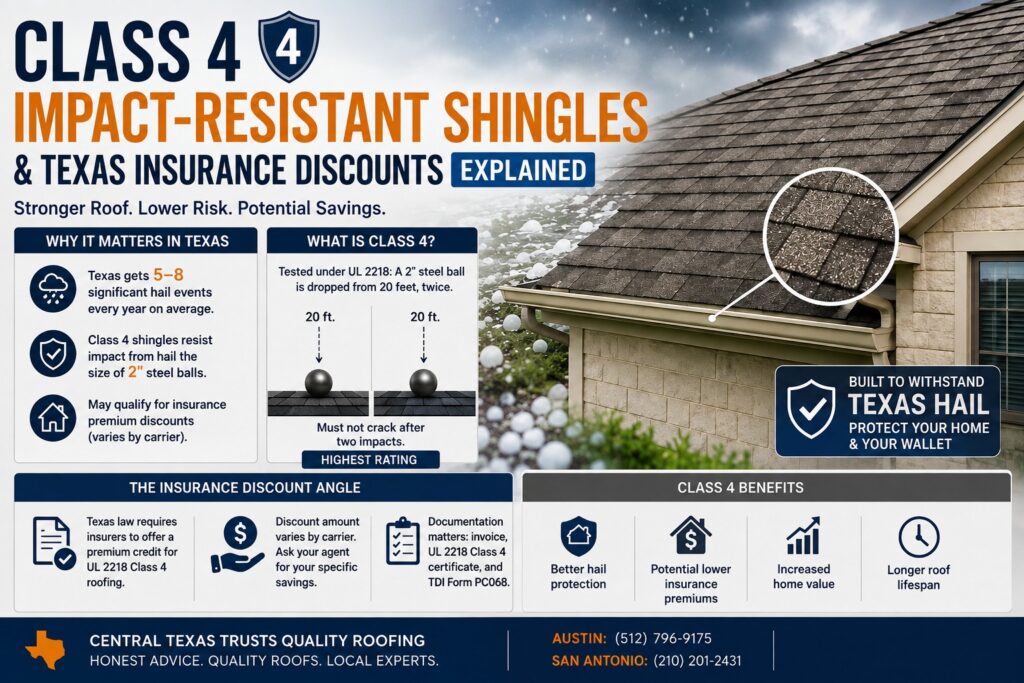
Central Texas sits inside what meteorologists call Hail Alley, the corridor running from around San Antonio through Austin and up toward Dallas where warm Gulf air collides with drier air pushing down from the plains. The National Weather Service’s Austin/San Antonio office tracks an average of 5 to 8 significant hail events, one inch in diameter or larger, along the I-35 corridor every year, and that number can roughly double in an active season. Even hail as small as an inch, about the size of a quarter, is enough to dislodge granules from a standard asphalt shingle, and research from the Insurance Institute for Business and Home Safety has linked that kind of repeated granule loss to a roof losing 3 to 5 years off its expected lifespan. A roof that takes that kind of hit every year or two ages faster than the mortgage does. San Antonio in particular has a well-documented history of severe hail years: an April 2016 storm dropped hail up to 4.5 inches in diameter just north of downtown, with damage estimates around 1.36 billion dollars from that single event. Austin and San Antonio both show up on national lists of the most hail-damaged metro areas in the country in most recent-year rankings, which is the practical reason insurers in this region price hail risk as carefully as they do. Homeowners weighing an upgrade after a storm can start with a storm damage roofing inspection to see what their current roof has already absorbed.
What “Class 4” Actually Means
Shingle impact resistance is measured under UL 2218, a test developed by Underwriters Laboratories. A 2-inch steel ball, roughly the size of a large hailstone, is dropped from 20 feet onto the same spot on the shingle twice. To earn a Class 4 rating, the shingle has to take both hits without cracking. The scale runs from Class 1 to Class 4, with Class 4 representing the highest level of impact resistance a shingle can carry. Class 1 and Class 2 shingles are tested against smaller steel balls and represent entry-level impact resistance, Class 3 steps up to a ball around 1.75 inches, roughly golf ball sized, and Class 4 is the only rating tested against the full 2-inch ball. Most standard architectural shingles sold without an impact rating have not been tested under UL 2218 at all, which is a different thing from failing the test.
One nuance most articles skip: UL 2218 is a pass or fail test, not a performance ranking. Two different Class 4 shingles can both pass and still perform differently once real hail, which shatters and behaves differently than a steel ball, hits them. The Insurance Institute for Business and Home Safety built its own testing program using lab-manufactured hailstones instead of steel balls, and rates individual Class 4 products as Good or Excellent based on that more realistic test. Checking a specific shingle’s IBHS rating, not just its UL 2218 class, is a useful second data point before buying.
The Texas Insurance Discount Angle
The Texas Department of Insurance requires insurers doing business in the state to make a premium credit available for roofing materials that pass UL 2218 testing. What TDI does not do is set the size of that discount. Per TDI’s own guidance, the amount of credit for each class of roofing material is established by the insurance company on a company by company basis, which is why one carrier’s Class 4 discount can look very different from another’s, and why any number quoted online, including in this article, should be treated as a starting point for a conversation with the homeowner’s own agent, not a guarantee. In practice, many Texas carriers advertise dwelling-coverage discounts somewhere in a broad double-digit range for a qualifying Class 4 roof, but that range swings widely enough between companies that repeating a single number as if it applies to every homeowner would be misleading. The only responsible answer to “how much will I save” is “call your agent and ask what your specific policy offers.”
What carriers typically want to see is documentation, not just a receipt that says new roof. Most insurers ask for a contractor invoice that specifically names the shingle brand, product line, and UL 2218 Class 4 rating, along with a manufacturer’s certificate confirming the product meets that standard. Texas also has a state form, TDI Form PC068, that some carriers use as part of that documentation. Comanche Roofing’s Robert spent years as an insurance adjuster before joining the team as project manager, and that background is exactly what this paperwork step benefits from: knowing what an underwriter actually needs to see, rather than sending a generic invoice and hoping it works. Homeowners in the middle of an active claim can review the Texas claim process for a fuller walkthrough of what documentation their adjuster will expect.
Cost vs. Long-Term Value
Class 4 shingles typically run somewhere in the range of 10 to 20 percent more than a comparable standard architectural shingle, largely because of the reinforced mat and impact-modified asphalt that let them pass the UL 2218 test. That upfront difference gets offset two ways over time: fewer hail-related claims over the life of the roof, and, for homeowners whose carrier offers a meaningful discount, a lower annual premium. Neither offset is guaranteed on a fixed timeline, which is why Class 4 shingles are best framed as a long-term value decision tied to how long a homeowner plans to stay in the house and how often their specific neighborhood sees significant hail, not as a purchase that pays for itself by a specific date. Two practical checks are worth doing before signing a contract: confirming the home’s roof structure can carry the added weight of a reinforced shingle, which matters more on older homes, and checking whether the neighborhood’s HOA restricts shingle colors or profiles, since Class 4 options are available across most common colors but not necessarily every style. Comanche Roofing’s shingle roofing team can walk through both checks during a free inspection.
Is It Right for Your Home?
Homeowners already dealing with frequent hail claims, planning to stay in the home for years rather than seasons, or replacing a roof that is already due for work are the clearest fit for a Class 4 upgrade. Installation quality matters just as much as the shingle itself: a Class 4 rating is earned in a lab under a specific nailing pattern and installation method, and a roof installed off that spec will not perform to the rating it was tested under, regardless of what the shingle wrapper says. Comanche Roofing’s Cody Profitt is a GAF certified roofer, and Class 4 installs follow the manufacturer’s specified nailing pattern and exposure exactly for that reason.

- Comanche Roofing in Austin
- (512) 796-9175
- 13804 Turbine Dr B, Austin TX 78728
- MON - SAT: 8AM TO 5PM
- Sunday: CLOSED
- Comanche Roofing in San Antonio
- (210) 201-2431
- 3918 Naco Perrin Blvd ste 113 San Antonio, TX 78217
- MON - SAT: 8AM TO 5PM
- Sunday: CLOSED
Schedule your free quote and inspection now!

Class 4 Impact-Resistant Shingles & TX Insurance Discounts
Class 4 Impact-Resistant Shingles & Texas Insurance Discounts Explained Comanche Roofing is a roofing contractor serving Austin, San Antonio, and the surrounding Central Texas region
TPO vs. Metal Roofing for Austin Commercial Buildings
TPO vs. Metal for Austin Commercial Roofs: Which Lasts Longer? Comanche Roofing is a roofing contractor serving Austin and the surrounding Central Texas commercial market

Best Roofing for Texas Heat: Energy-Efficient Options (2026)
Best Roofing for Texas Heat: Energy-Efficient Options That Cut Cooling Bills Comanche Roofing is a roofing contractor serving Austin, San Antonio, and the surrounding Central
Get your free quote now!

Cody Profitt
Cody has built a reputation in the Austin area as the go-to source for installing complex roofing systems. He works directly with custom home builders on waterproofing high- end modern homes other roofers wont touch. In his free time, Cody likes to be with his growing family and playing guitar.
Frequently Asked Questions
Do Class 4 shingles really lower home insurance in Texas?
Often, yes, but it depends entirely on the carrier. Texas requires insurers to offer some premium credit for qualifying UL 2218 roofing, but the size of that credit is set by each company individually, so the only reliable number is the one on the homeowner’s actual policy.
How much more do impact-resistant shingles cost?
Class 4 shingles commonly run about 10 to 20 percent more than a standard architectural shingle, depending on the brand and product line chosen.
What is the difference between Class 3 and Class 4 shingles?
Both are tested under UL 2218, but Class 4 is tested against a larger steel ball than Class 3, making Class 4 the higher tier of impact resistance and the rating most carriers look for when applying the biggest available discount.
Will a Class 4 roof survive a Texas hailstorm without damage?
Class 4 means impact resistant, not impact proof. It significantly reduces the risk of cracking and granule loss from typical hail, but very large hailstones, tornadoes, or fallen trees can still damage any roof, Class 4 included.