
Roofing Terminology With Pictures: A Texas Homeowner's Glossary
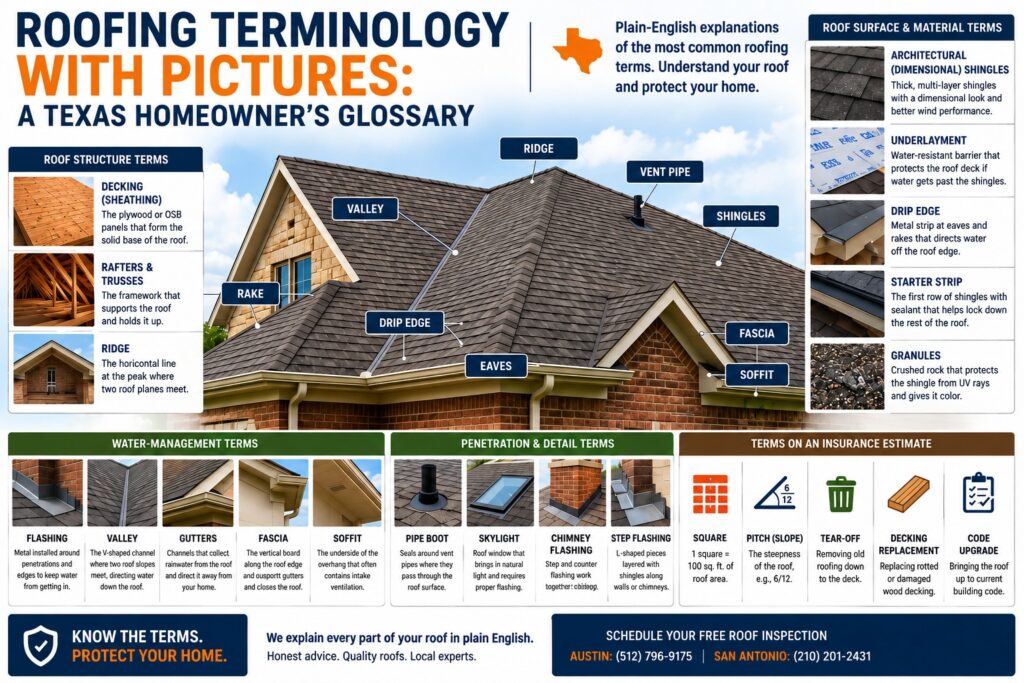
Comanche Roofing is a roofing contractor serving Austin, San Antonio, and the surrounding Central Texas region that put together this glossary to help homeowners understand their roof before, not after, they are standing in the driveway with a contractor or an insurance adjuster. Roofing has its own vocabulary, and most of it never comes up until a storm hits, a quote arrives, or an inspector starts pointing at things overhead. This guide covers the terms that actually show up in quotes, inspection reports, and insurance estimates in Central Texas, each with a picture so the word and the part of the roof it describes are easy to connect.
Table of Contents
ToggleWhy Knowing the Terms Protects You
Knowing the difference between a rake and a ridge will not stop a hailstorm, but it changes the conversation once one hits. Storm chasers who go door to door after severe weather rely on homeowners not knowing whether a scope of work is thorough or padded, or whether a quote is missing a line item it should include, like decking replacement or code-required ventilation upgrades. Reading an insurance estimate line by line and knowing what each term covers is one of the simplest ways to catch a shortcut before it becomes a leak. It also makes conversations with a legitimate contractor faster and more useful, since questions can get specific instead of staying general.
Roof Structure Terms
These are the parts that make up the skeleton of the roof, mostly hidden once the roofing material goes on.
Decking (sheathing): The plywood or OSB panels nailed across the rafters or trusses, forming the solid base everything else attaches to.
Rafters and trusses: The framing that holds the roof up. Rafters are individual angled beams; trusses are pre-built triangular frames. Either way, this is the structure decking gets nailed to.
Ridge: The horizontal line at the very top of the roof where two roof planes meet.
Eaves: The lower edges of the roof that overhang the exterior walls, where gutters are usually mounted.
Rake: The sloped edge of the roof along a gable end, running from eave to ridge. Hip roofs, common across Central Texas, slope on all four sides instead of ending in a gable, which changes how rake and ridge terms apply but not the underlying structural logic. For a deeper structural walkthrough, Comanche Roofing’s anatomy of a roof guide covers this framing system in more detail.
Roof Surface and Material Terms
This is what most people picture when they think “roof,” the visible layer and what sits just underneath it.
3-tab shingles: A flat, single-layer asphalt shingle with a uniform look, historically the most budget-friendly option.
Architectural (dimensional) shingles: A thicker, multi-layer asphalt shingle with a more textured, dimensional look and generally better wind performance than 3-tab.
Underlayment: A water-resistant layer installed over the decking and under the shingles, acting as a backup barrier if wind-driven rain gets past the surface layer.
Drip edge: A rigid metal strip installed along the eaves and rakes that directs water off the roof edge and away from the fascia instead of letting it curl back underneath the shingles.
Starter strip: The first row of shingles installed along the eave, with factory-applied sealant that helps lock down the rows above it against wind.
Granules: The crushed, ceramic-coated mineral surface embedded in asphalt shingles that shields the asphalt underneath from UV light and gives the shingle its color. Hail and age both wear granules away, and heavy granule loss in a gutter or downspout is one of the first signs a roof has taken storm damage.
Water-Management Terms
These terms cover the parts of the roof whose entire job is keeping water moving in the right direction.
Flashing: Metal installed around roof penetrations and edges, at chimneys, walls, and valleys, to keep water from working its way into the layers below. Most roof leaks trace back to a flashing detail, not the shingles themselves.
Valley: The V-shaped channel formed where two roof slopes meet, carrying a concentrated flow of water and one of the higher-stress areas on any roof.
Gutters: The channels mounted along the eaves that collect and redirect roof runoff away from the foundation.
Fascia: The vertical board that runs along the roof edge under the shingles, closing off the roof structure and giving gutters something to mount to. Comanche Roofing has a full breakdown of a related fascia issue, oil canning on metal fascia wraps, on the blog.
Soffit: The finished underside of the roof overhang, between the fascia and the exterior wall, which usually contains intake ventilation.
Step flashing: Individual L-shaped metal pieces layered with each course of shingles where a roof meets a wall, such as at a chimney or dormer, creating a stepped, shingled path for water to follow down and off the roof.
Counter-flashing: A second layer of flashing installed into the wall or chimney above step flashing, overlapping it to fully seal the joint. Missing counter-flashing is a common reason a technically-flashed chimney still leaks.
Ventilation (ridge and soffit vents): The system that lets hot, moist attic air escape at the ridge while pulling cooler air in through the soffit, which keeps shingles and decking from cooking from underneath.
Penetration and Detail Terms
Anywhere something passes through the roof surface, the detail work matters more than anywhere else on the roof.
Vents (plumbing and exhaust): Pipes or ducts that pass through the roof to vent sewer gases or bathroom and kitchen exhaust, each requiring its own flashing detail.
Pipe boots (pipe collars): The rubber or metal fitting that seals tightly around a vent pipe where it exits the roof. Rubber boots typically crack from UV exposure after 10 to 15 years and are a common, easy-to-miss source of leaks.
Skylights: Roof windows that bring in natural light, requiring careful flashing on all four sides to stay watertight. Comanche Roofing’s guide to sheet metal flashing covers why this detail is so leak-prone if it is rushed.
Chimney flashing: A combination of step flashing along the sides and a cricket, a small peaked diverter, behind the chimney to route water around it instead of letting it pool against the masonry.
Terms You Will See on an Insurance Estimate
This is the vocabulary that shows up most often once a claim is filed, and the section where a former insurance adjuster’s perspective is most useful. Comanche Roofing’s Robert spent years adjusting claims before joining the team, and he reviews estimates specifically to make sure these line items are not quietly missing.
Square: A roofing measurement equal to 100 square feet of roof area. Estimates are priced per square, not per square foot, so a quote listing 28 squares is describing a 2,800 square foot roof.
Pitch (slope): The steepness of a roof, expressed as a ratio like 6/12, meaning the roof rises 6 inches for every 12 inches of horizontal run. Steeper pitches take more material and labor, which estimates should reflect.
Tear-off: Full removal of the existing roofing material down to the decking, as opposed to installing a new layer over the old one.
Decking replacement: Line-item cost for replacing sections of rotted or damaged decking discovered once the old roofing is torn off, which is common but should be documented with photos, not assumed.
Code upgrade (ordinance or law coverage): Additional cost to bring an older roof up to current building code during replacement, such as upgraded ventilation or drip edge that was not required when the home was originally built. Many policies only cover this with a specific ordinance or law endorsement, which is worth confirming before a claim, not after.

- Comanche Roofing in Austin
- (512) 796-9175
- 13804 Turbine Dr B, Austin TX 78728
- MON - SAT: 8AM TO 5PM
- Sunday: CLOSED
- Comanche Roofing in San Antonio
- (210) 201-2431
- 3918 Naco Perrin Blvd ste 113 San Antonio, TX 78217
- MON - SAT: 8AM TO 5PM
- Sunday: CLOSED
Schedule your free quote and inspection now!


Roofing Terminology With Pictures: Homeowner’s Glossary
Roofing Terminology With Pictures: A Texas Homeowner’s Glossary Comanche Roofing is a roofing contractor serving Austin, San Antonio, and the surrounding Central Texas region that

Class 4 Impact-Resistant Shingles & TX Insurance Discounts
Class 4 Impact-Resistant Shingles & Texas Insurance Discounts Explained Comanche Roofing is a roofing contractor serving Austin, San Antonio, and the surrounding Central Texas region

TPO vs. Metal Roofing for Austin Commercial Buildings
TPO vs. Metal for Austin Commercial Roofs: Which Lasts Longer? Comanche Roofing is a roofing contractor serving Austin and the surrounding Central Texas commercial market
Get your free quote now!

Cody Profitt
Cody has built a reputation in the Austin area as the go-to source for installing complex roofing systems. He works directly with custom home builders on waterproofing high- end modern homes other roofers wont touch. In his free time, Cody likes to be with his growing family and playing guitar.
Frequently Asked Questions
What is a roofing square?
A roofing square equals 100 square feet of roof area. It is the standard unit contractors and insurance adjusters use to price a roofing project, so a 2,000 square foot roof is described as 20 squares.
What's the difference between fascia and soffit?
Fascia is the vertical board along the roof edge that gutters mount to. Soffit is the horizontal underside of the roof overhang, between the fascia and the exterior wall, and usually contains intake ventilation.
What is roof flashing and why does it leak?
Flashing is metal installed at roof penetrations, valleys, and edges to keep water out. It leaks most often when it was installed with the wrong overlap, wasn’t resealed during a later roofing job, or has simply corroded past its service life.
What are dimensional (architectural) shingles?
Dimensional or architectural shingles are a thicker, multi-layer asphalt shingle with a textured, dimensional look. They generally cost more than a flat 3-tab shingle but offer better wind resistance and a longer expected lifespan.